


Offices are low-risk buildings that carry a high-consequence problem. There is little food production, no waste stream to speak of, and a cleaning contract that runs every night. What there is instead is several hundred people who did not come to work expecting to think about pests, and who will all hear about it at once.
That changes what good looks like. In a warehouse the cost of a problem is written-off stock, and in a restaurant it is a closure. In an office it is a floor of people who no longer want to eat at their desks, a facilities team fielding questions it cannot answer, and a landlord conversation nobody had prepared for. The treatment is usually straightforward. The handling is what people remember.
The second thing that makes offices different is that you almost certainly do not control your own building. The riser, the ceiling void, the basement plant room, the shared bin store and the tenant two floors down are all outside your demise and usually outside your contract. Activity does not respect that boundary, and the gap between the landlord's pest provision and yours is where most persistent office problems actually live.
Nightshift works these buildings after the floor empties. Technicians are on shift through the night as standard rather than being called out, so inspection, treatment and proofing happen with nobody at a desk, no notice to staff, and no out-of-hours premium, because nights are simply when we work. Every visit produces a written report the same day.
What actually matters in an office
A sighting is a communications event before it is a pest event
One mouse crossing a floor plate reaches the whole company faster than it reaches facilities, and by the time anyone official knows, the story has already been told several times. What limits the damage is having a reporting route that exists before the day it is needed: who staff tell, what they are told back, and how quickly. We would rather set that up at the start of a contract than write it during an incident.
The breakout kitchen nobody owns
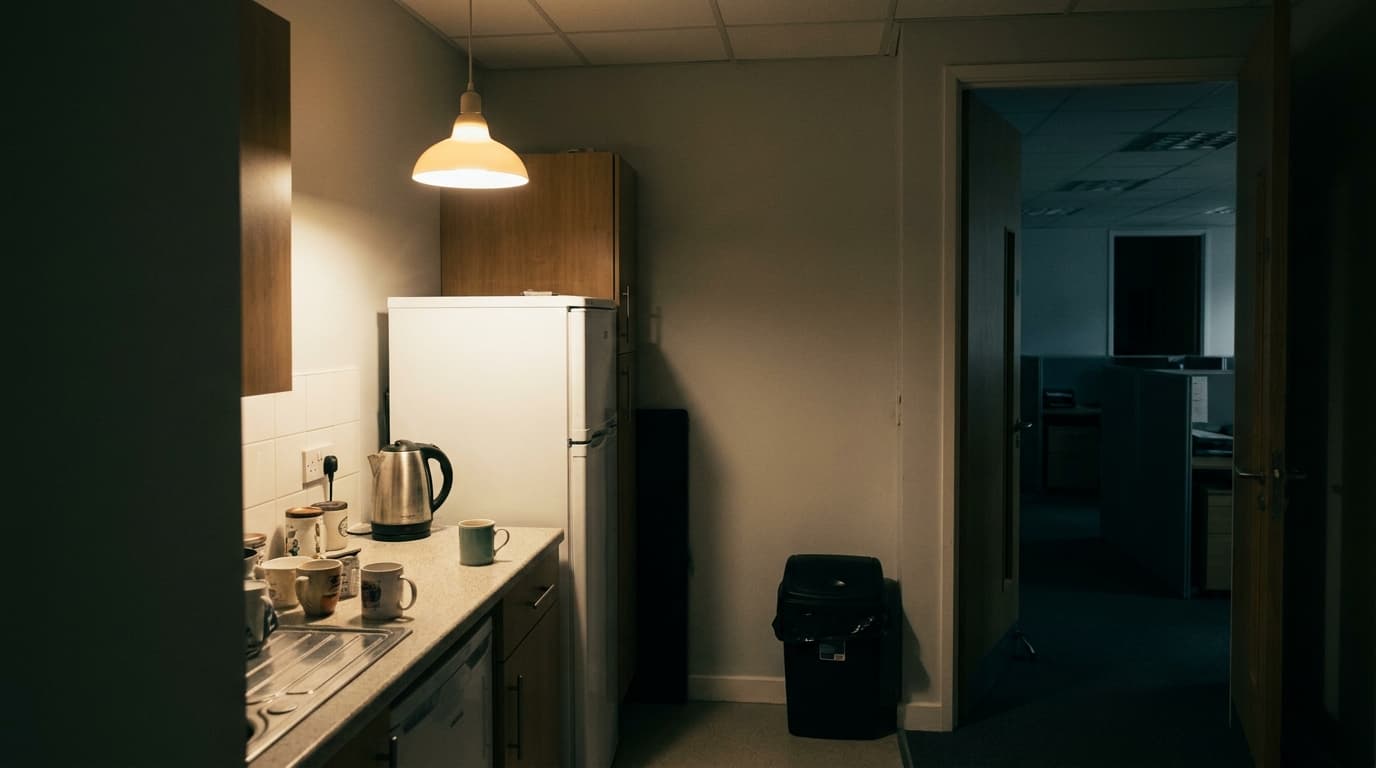
Offices removed the canteen and the catering staff who came with it, and replaced it with a kitchen used by two hundred people and owned by none of them. The recurring findings are the same everywhere: under and behind the fridge, the dishwasher void, the gap beside the units, and a bin that is emptied nightly but has never been cleaned. It is the single most productive twenty minutes of any office survey.
Hybrid working left food in furniture
A desk occupied two days a week still holds what was put in it on the other five, and pedestal drawers are now the most common harbourage we find on an office floor. Desk bins are the same story: emptied by cleaners into one central store, which concentrates every floor's food waste into a single room that is often the least well proofed part of the building.
The parts of the building that are not yours
In a multi-let building the ceiling void, the service riser, the basement and the shared refuse store usually sit with the landlord, while your contract stops at your demise. Activity moves vertically through exactly those spaces. We will tell you plainly when the finding is outside your control, and put it in writing in terms you can hand to the managing agent, because a report that only covers your floor cannot solve a building problem.
The route is above the ceiling, not across the floor
Open-plan floors are clean, bright and genuinely low risk at eye level, which is why treating what people can see achieves so little. Movement happens in the ceiling void, along cable trays and through the vertical services, and monitoring has to be placed to that rather than to the skirting line where it is easy to service and easy for staff to notice.
Working around an occupied building, which means not being in it
An office cannot be treated properly while people are sitting in it, and a daytime visit is limited to the places nobody minds you looking. Night working is the standard shift here rather than an upgrade: full access to kitchens, voids, risers and plant, no disruption to the working day, no notice needed to staff, and a written report waiting the same day.
Common questions
Do you cover offices outside London?
Yes, and most of this work is outside it. The thirty-minute attendance target applies to London and London only. Coverage runs across the South East, Kent, East Anglia and the East of England, the Midlands, Manchester and the North West, and the West of England, with foot teams in Birmingham and Manchester. We would rather state the real position than publish one response time and hope it is close enough.
We are one tenant in a larger building. Whose responsibility is this?
Usually both, split in a way that is rarely written down. Your demise is yours; the risers, voids, basement and shared bin store normally sit with the landlord or managing agent. The practical answer is that a survey should cover the whole route rather than stopping at your door, and that our report is written so you can hand the parts outside your control straight to the agent. Problems that keep coming back in multi-let buildings are almost always living in that gap.
Can you work outside office hours?
That is the standard arrangement rather than a special one. Technicians work nights as their normal shift, so we are in the building when it is empty, with access to the kitchens, ceiling voids and risers that a daytime visit cannot reach. There is no out-of-hours premium, because there is no out of hours.
Somebody saw a mouse and it is already all over the staff chat. What now?
Two things in parallel. We attend and find the route, which is the part that actually resolves it. And you need something to say by the end of the day, which is where most organisations struggle, because saying nothing reads as concealment and over-promising creates a second problem when it recurs. We will give you the factual position in writing the same day, including what we do not yet know, so that what you tell staff is accurate and does not need retracting.
Do we need a contract, or can you just come out once?
Either. A single visit is the right answer for a one-off sighting in a building with no history, and we will say so rather than selling a programme against it. A contract earns its place where there is a shared building, a recurring finding, or a facilities team that needs a documented position for the landlord or for insurance. The survey is free and without obligation either way.
Will our cleaning contractor not deal with this?
They deal with the part that is visible, which matters but is not the same job. Cleaning empties the bin; it does not usually clean under the fridge, behind the units or inside the dishwasher void, and those are the places findings come from. The most useful outcome of a survey is often a short list of things the cleaning specification should include, which costs nothing and removes the reason the problem keeps returning.
Related: offices in London specifically, facilities management, building proofing, and commercial pest control. For a whole estate on one agreement, see commercial pest control contracts.
A survey costs nothing and often ends in advice rather than a contract
Surveys, quotations and advice are free and without obligation, one floor or a whole estate. In an office the most useful hour we can spend is in the kitchen, the bin store and the ceiling void, and telling you honestly where the answer is a change to the cleaning specification rather than a pest contract.
Arrange a survey