

Falconry, hawking & bird of prey
Falconry bird control
Some sites cannot be netted. A stadium roof, a landfill face, a food production yard or a listed facade either has no practical fixing points, or is protected in a way that forbids them. Falconry works where hardware cannot go.
The principle is behavioural rather than lethal. Flying a trained hawk over a site reinstates the one thing feral pigeons and gulls have stopped expecting in a city: a predator overhead. Birds do not need to be caught for the effect to work. They need to stop believing the roof is safe, and they relocate accordingly.
Nightshift flies its own birds. The falconry team is ours rather than a subcontractor booked in for the day, which is what makes a sustained programme practical: the same handlers, the same birds, and a flying schedule we control rather than one we have to negotiate.
How the programme runs
Flights are scheduled to the site's rhythm and the birds' behaviour, usually at dawn and dusk when roosting pressure peaks. Dispersal is a programme rather than a visit: sustained flying over weeks breaks the roosting habit, and is normally paired with proofing so the birds do not simply return once flying stops.
Where this sits in the group
Bird control across the group is led by JG Pest Control, our sister company within Tyro UK. Nightshift flies its own hawks for London commercial sites, listed facades and anywhere hardware cannot be fixed — that work stays with us. For bird proofing, netting, spikes, solar panel protection, seagull control or anything outside London, JG is the group's bird division and the better place to start.
JG Pest Control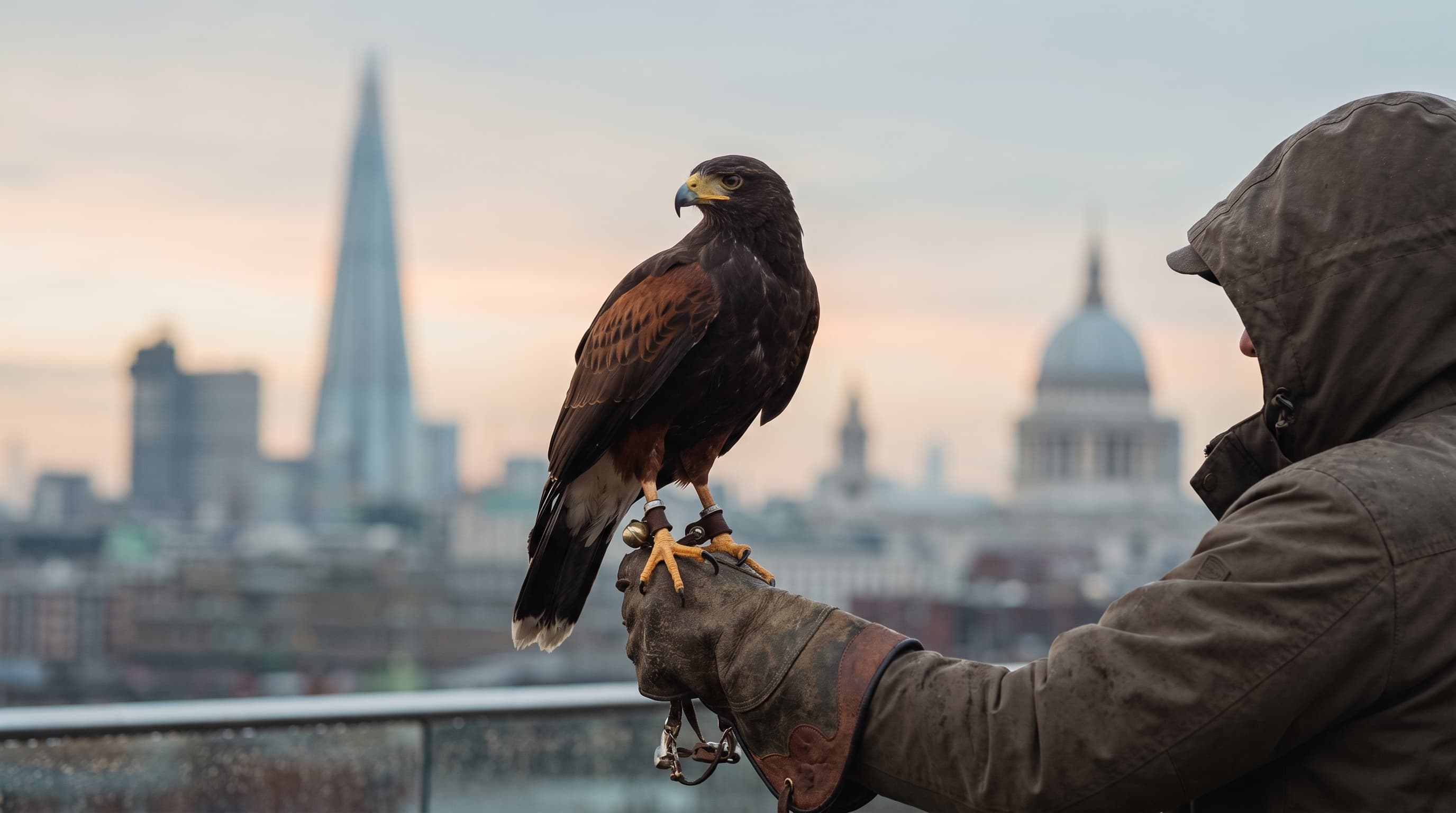
Why it works
What this method actually does.
It disperses rather than kills
The hawk is flown as a deterrent. Success is measured in birds choosing to roost elsewhere, not in birds taken, which is what makes the method acceptable on public-facing and welfare-sensitive sites.
It reaches what proofing cannot
Large open spans, stadium roofs, waste transfer floors and quaysides have no realistic netting solution. Flying covers the whole airspace rather than a single ledge.
Listed and protected fabric stays untouched
Where consent forbids fixing spikes, netting or wire into historic stone and lead, falconry leaves the building entirely unaltered.
Our own team, our own birds
Most pest control companies subcontract falconry, which makes a sustained schedule difficult and continuity impossible. Our falconry team and birds are in-house, so the same handlers work your site to a schedule we control.
Gulls need care and often a licence
All wild birds are protected under the Wildlife and Countryside Act 1981, and several gull species are now of serious conservation concern with licensing tightened accordingly. Non-lethal dispersal avoids much of that exposure.
Where it is used
Sites that suit it.
- Stadium roofs, stands and concourses
- Shopping centres, retail parks and public squares
- Food production yards, loading areas and waste transfer sites
- Landfill and recycling facilities
- Docks, quaysides and marine terminals
- Listed buildings, cathedrals and heritage roofscapes
- Hospital, campus and business park estates
Compliance & evidence
All wild birds are protected under the Wildlife and Countryside Act 1981, and any work touching nests or protected species is assessed against that before anything is scheduled. Falconry is used as a non-lethal dispersal method, with the birds themselves kept and flown to proper welfare standards. Written reports record each flight, the response observed and the recommendation, so the programme is evidenced rather than assumed.
Certificates published, not promised
BPCA member M15/1628, CEPA certified to EN 16636, CHAS, SafeContractor and Constructionline, with numbers and expiry dates on our procurement page.
Common questions
Falconry & bird of prey control, answered.
The questions facilities and operations teams raise most, answered plainly.
Do the hawks kill the pigeons or gulls?
No. The birds are flown as a deterrent. The presence of a predator over the site is what changes roosting behaviour, and the pest birds relocate rather than being taken.
How long before it works, and does it last?
Dispersal is a sustained programme rather than a single visit, because a roosting habit built over years does not break in an afternoon. It holds best when combined with proofing, so the site is unattractive as well as unsafe once flying reduces.
Is it legal, and what about protected species?
All wild birds are protected under the Wildlife and Countryside Act 1981, and several gull species now carry additional protection. Non-lethal dispersal is precisely why falconry suits sites where lethal control would be difficult to licence or to defend publicly.
Do you subcontract the falconry?
No. Nightshift has its own falconry team and its own birds. That matters for a programme rather than a one-off visit: the same handlers learn your site, and the flying schedule is ours to set rather than a third party's availability.
Can you combine it with netting and spikes?
Usually we recommend exactly that. Our bird team are among the most experienced deterrent installers in the country and work at all heights, so flying handles the open airspace while proofing closes the ledges worth returning to.
Arrange a survey
London never sleeps.
Neither do we.
Call today for a no obligation quote, 24/7. Surveys, quotations and advice are free and without obligation.
office@nightshiftpestcontrol.co.uk
5 Linden Close, The Pantiles, Tunbridge Wells, TN4 8HH
BPCA member · CEPA · CHAS · SafeContractor