


We will give you the recommendation before the shopping list, because it is the part that matters. On housing stock, pest control should be carried out by a qualified contractor rather than by your repairs team, and that is not a sales position. It is the difference between a case that closes and a case that comes back with a complaint attached.
That is not an argument against your team ever touching anything. Somebody will fill a hole, somebody will put a bait block in a cupboard, somebody will buy a proofing kit. The point of this page is to be precise about which of those genuinely help, because in practice most of them make the problem last longer, and one of them is not legal for an uncertificated operative to buy at all.
The honest starting point is that products are the smaller half of this in any case. A pest problem in a block is a building problem: a defective drain, an open service penetration, a bin store that cannot be closed. No product on this page fixes any of those, and a programme built on consumables rather than repairs is a subscription rather than a solution. What good products do is hold a repair once it has been made, and give you evidence in the meantime.
Why this should not be an in-house job on housing stock
Every reason below is about housing specifically. None of them applies in the same way to somebody treating their own kitchen.
You are treating somebody else's home, not your own
A landlord placing poison in an occupied dwelling carries a duty of care to residents, children, pets and visiting staff that a householder simply does not carry for themselves. Where it goes wrong, the exposure sits with the organisation rather than with the operative who bought the product.
Your own team probably cannot legally buy the product anyway
Professional rodenticides are sold under the CRRU stewardship regime and a supplier is expected to ask for proof of competence at the point of purchase. The realistic in-house alternative is a consumer product, which is weaker, generally used in the open, and the usual route to a resistant population that then costs far more to clear.
The record is the deliverable, and an untrained visit does not produce one
When a case escalates to a complaint, a disrepair claim or an ombudsman, what protects the provider is a dated record of what was found, what was done, what access was achieved and what remains outstanding on somebody else's title. A repairs operative filling a hole produces a job line, not that record, and the gap only becomes visible at the moment it costs the most.
Untargeted baiting in communal areas creates its own liabilities
Loose or unsecured bait in a bin store, riser or void is reachable by children and pets and is a finding against you rather than a defence. Secondary poisoning of wildlife is a real consequence with a stewardship regime built around preventing it. Neither risk is worth the saving.
Treating the symptom hides the defect that is actually causing it
A case that returns after treatment is a structural defect until proven otherwise, and identifying which drain, penetration or shared void is responsible is a survey rather than a purchase. In-house treatment is very good at making activity disappear for a fortnight, which is exactly long enough for nobody to look for the cause.
Surveys, quotations and advice are free and without obligation. If the answer is that a repair is all you need, we will say so.
Arrange a surveyWhat your own team can legitimately hold
Everything below is proofing, hardware, monitoring or protective equipment. There is no rodenticide and no insecticide on this list, and that is deliberate.
Proofing materials, and the one to stop buying
Expanding foam is not a rodent-proofing material. Rats gnaw through polyurethane foam readily, and a hole filled with it reads as repaired on a job sheet while remaining open in practice. What holds is a physical barrier the animal cannot work: stainless or galvanised wire wool packed tight and mortared over, sheet metal or perforated plate at larger openings, cement-based filler with aggregate rather than a soft mastic, and proprietary brush strips or door sweeps at thresholds. Specify by what it resists, not by what fills the gap fastest.
Drain gates, rodding eye covers and gully guards
On most estates the reservoir is the drainage rather than the building, so the highest-value product on this list is usually the cheapest: a non-return drain gate or a properly seated rodding eye cover on the runs serving a block. They are also the items most often missing after groundworks. Worth auditing what is actually fitted before buying anything that goes indoors.
Tamper-resistant bait housings for communal areas
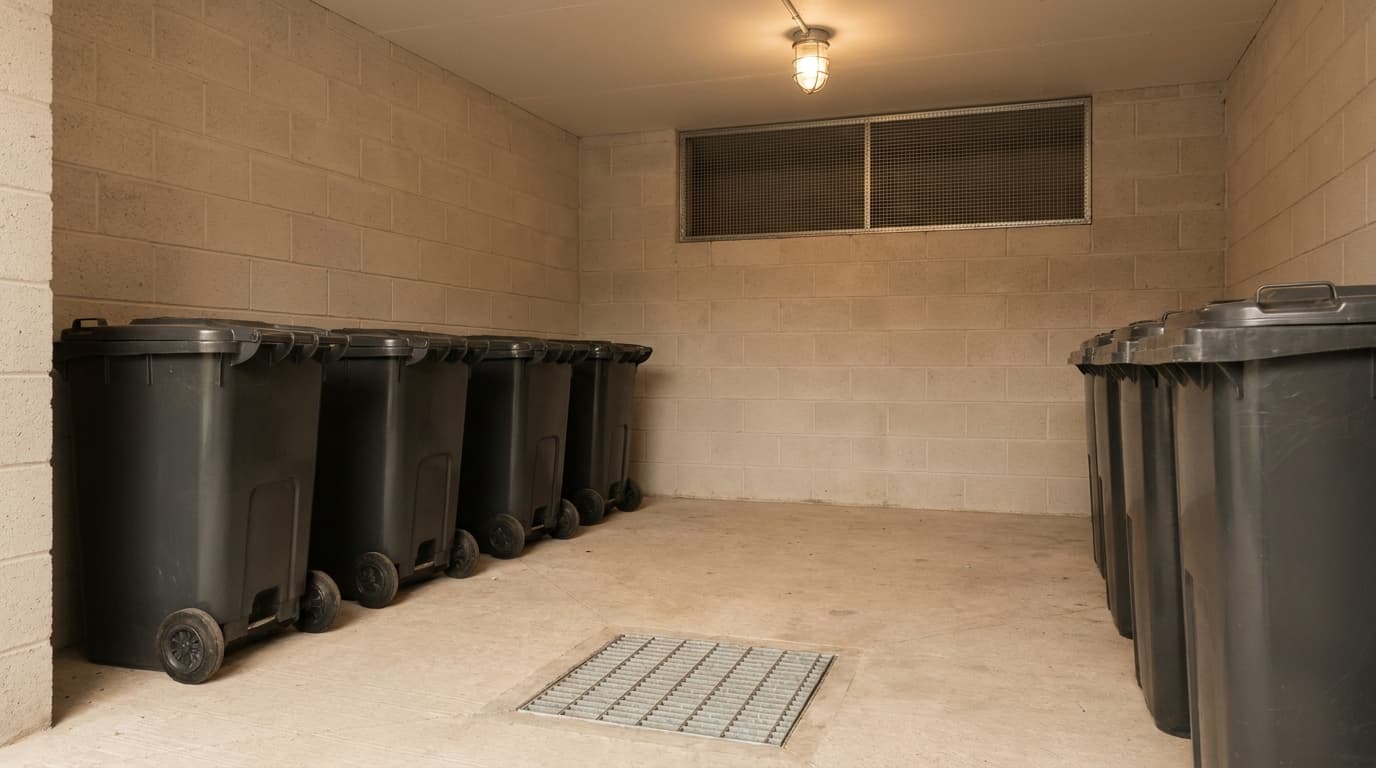
Anywhere the public, children or pets can reach, a bait point has to be in a lockable tamper-resistant housing, fixed down, and recorded. Loose bait blocks in a bin store or riser are an avoidable liability as well as being poor practice. The housing is the part to specify carefully; it outlasts many years of consumables.
Monitoring, so you find out before the resident tells you
Non-toxic monitors and, on larger or higher-risk sites, remote sensing give you dated evidence of activity in the places nobody inspects weekly: risers, duct runs, chute chambers, voids. On housing stock the value is less about early treatment and more about having a record of what was happening and when, which is exactly what an escalation asks for.
PPE, waste handling and the unglamorous rest
Gloves, coveralls, respiratory protection where it is warranted, sharps and waste handling for clearances, and secure storage for anything hazardous. If your team is doing first-line work at all, this is not optional, and it is the part most often absent from a repairs stores order.
What should never be done in-house
- Rodenticide of any kind, in any location, including consumer product bought to work around the certification requirement.
- Insecticide treatment in occupied dwellings or communal areas, including fogging and residual sprays.
- Baiting communal areas, bin stores, risers, voids and undercrofts, where public access makes unsecured product a finding against you.
- Any treatment that is going to be relied on later as evidence, because an untrained visit does not produce a record that survives scrutiny.
- Deciding that a recurring case is solved, which is a survey judgement rather than an observation that activity has stopped.
If an item on this list is already happening on your stock, that is worth a conversation before it is worth a purchase order.
The certification rule that decides most of this
Professional rodenticides in the UK are sold under the CRRU stewardship regime, and a supplier is expected to ask for proof of competence at the point of purchase: an approved certificate, or membership of an approved scheme. A repairs operative without one cannot simply buy professional product, and a supplier who sells it without asking is not doing you a favour.
That constraint is worth designing around rather than working around. In practice it means the sensible split is that your team owns proofing, drainage hardware, monitoring and housekeeping, and a contractor owns anything involving a rodenticide, the record that goes with it, and the survey that decides where it belongs at all.
Where to buy
For the narrow set above, the proofing, hardware, monitors and PPE a housing team can legitimately hold. Not for treatment product, which should be a contractor’s purchase and a contractor’s responsibility. Two of these are companies within our own group and are labelled as such, because a recommendation that hides an interest is worth nothing, and we buy from them ourselves. The others are named on neutral fact. We do not publish a price comparison table: none of them publishes pricing openly enough for one to stay accurate, and a table that goes stale is worse than no table.
PestFix
Tyro Group companyTyro group company. Broad professional and DIY range with proofing, drainage and bird control well covered, and technical staff who will say when a product is the wrong answer, which matters more on housing stock than range size does. In our own buying experience it is also usually the most competitively priced of the major UK distributors on like-for-like lines, though see the note below on why we do not publish a comparison table.
Enviroguard
Tyro Group companyTyro group company, pest control product supply.
Long-established professional distributor, widely used across the trade.
Trade distributor covering professional pest control supply.
Manufacturer and supplier of professional pest control products.
Common questions
Should a housing association do its own pest control or use a contractor?
Use a contractor. On housing stock you are treating somebody else's home, which carries a duty of care to residents, children and pets that a householder does not carry for themselves; your team almost certainly cannot legally buy professional rodenticide; and the dated record a contractor produces is what protects you when a case becomes a complaint or a disrepair claim. In-house work is well suited to proofing, drainage hardware, monitoring and housekeeping, and poorly suited to everything else.
What pest control products can a housing repairs team legitimately hold?
Proofing materials that resist gnawing rather than merely fill a gap, drain gates and rodding eye covers, empty tamper-resistant bait housings, non-toxic monitors, and PPE. Note what is not on that list: no rodenticide, no insecticide and no treatment of any kind. Those belong to a qualified contractor, and the drainage hardware is usually the cheapest item you will buy and the one that changes the most.
Can I use expanding foam to block a rat hole?
No. Rats gnaw through polyurethane foam, so a hole filled with it is recorded as repaired while remaining open. Use wire wool packed tight and mortared over, sheet metal or perforated plate at larger openings, or a cement-based filler with aggregate. If the same hole keeps reopening, the real question is what is on the other side of it, and that is a survey rather than a purchase.
Can a council or housing association repairs team buy professional rodenticide?
Not without proof of competence. Professional rodenticides are sold in the UK under the CRRU stewardship regime and a supplier is expected to ask for an approved certificate or scheme membership at the point of purchase. Buying consumer product instead is the common workaround and a poor one: it is weaker, usually deployed in the open, and it is the ordinary route to a resistant population that costs far more to clear later.
Is DIY pest control cheaper for a landlord?
Rarely, once the whole cost is counted. The saving is on the visit; the cost lands in repeat attendance, a resistant population, a case that escalates because nobody produced a record, and occasionally a liability from unsecured bait in a communal area. The one place in-house effort genuinely does save money is proofing and drainage, because those are permanent and they remove the reason the pests were there.
Do bait boxes need to be locked in communal areas?
Anywhere the public, children or pets can reach, yes: tamper-resistant, lockable, fixed down and recorded. In practice this is one of the clearest reasons communal baiting should not be an in-house task at all, because loose or unsecured bait is a finding against you rather than a defence, and it is exactly what an escalation looks for.
Will buying better products fix a recurring infestation?
Usually not on its own. A case that returns after treatment is a structural defect until proven otherwise, most often a drain, a service penetration or a bin store that cannot be closed. Good products hold a repair once it has been made. They do not substitute for the repair, they do not substitute for the survey that identifies it, and a programme built on consumables instead of repairs never finishes.
Where do housing providers buy pest control supplies in the UK?
For the narrow set a housing team should hold, proofing, drainage hardware, monitors and PPE, PestFix and Enviroguard are the suppliers within our own group and are where we would point you first. On price, our own buying experience is that PestFix is usually the most competitive of the major UK distributors on like-for-like lines, and we say that as an owner of it rather than as a neutral party. Killgerm, 1env Solutions and Barrettine Environmental are other established professional distributors. We do not publish a price comparison table, because none of them publishes pricing openly enough for one to stay accurate.
The service side of this sits on social housing pest control, the structural work on building proofing and rodent exclusion, and where a recurring case becomes a liability on pest control and housing disrepair.
Not sure what your stock actually needs?
Surveys, quotations and advice are free and without obligation, one block or a whole portfolio. We will tell you which of this belongs in your own stores and which needs a contractor, including where the answer is that you need neither.
Arrange a survey