

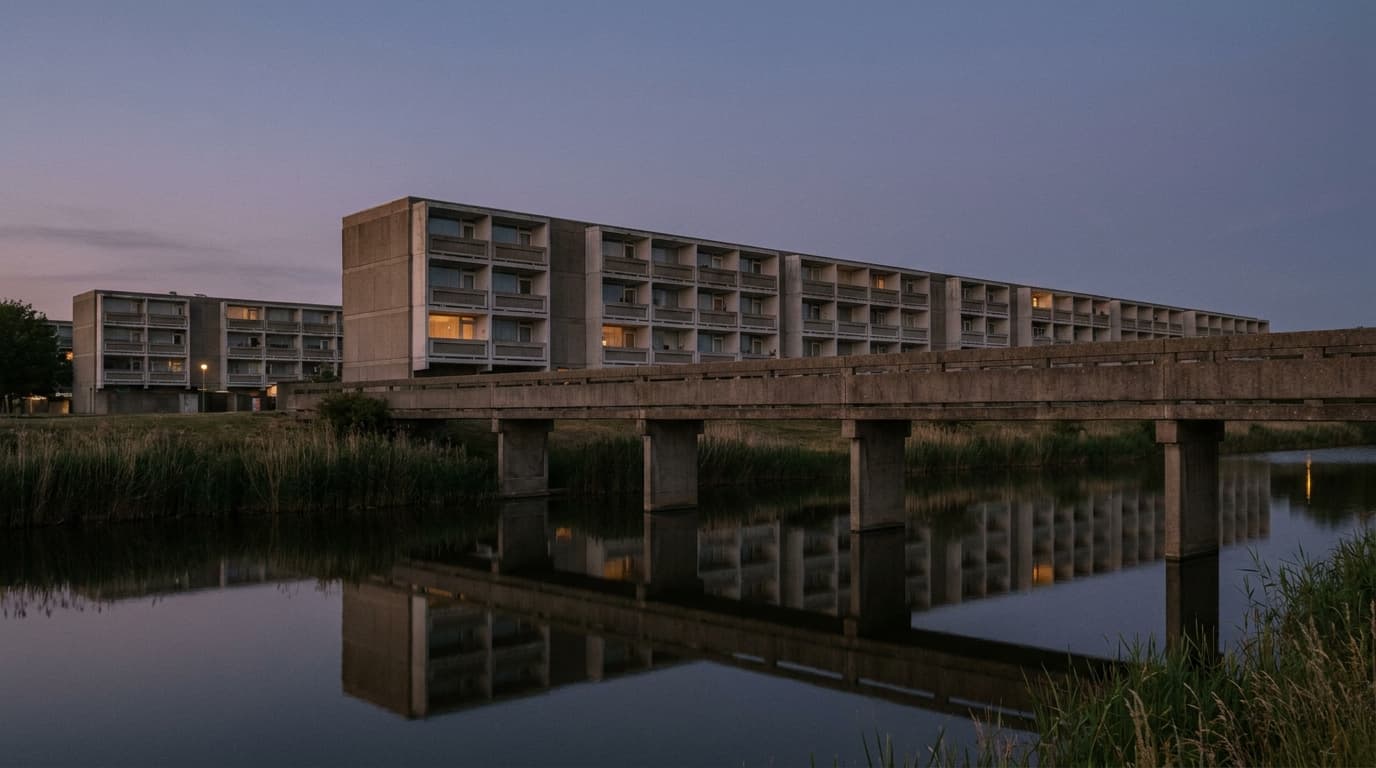
- Southmere Lake
- Abbey Wood station
- Harrow Manorway
- Crossway Park
- Birchmere
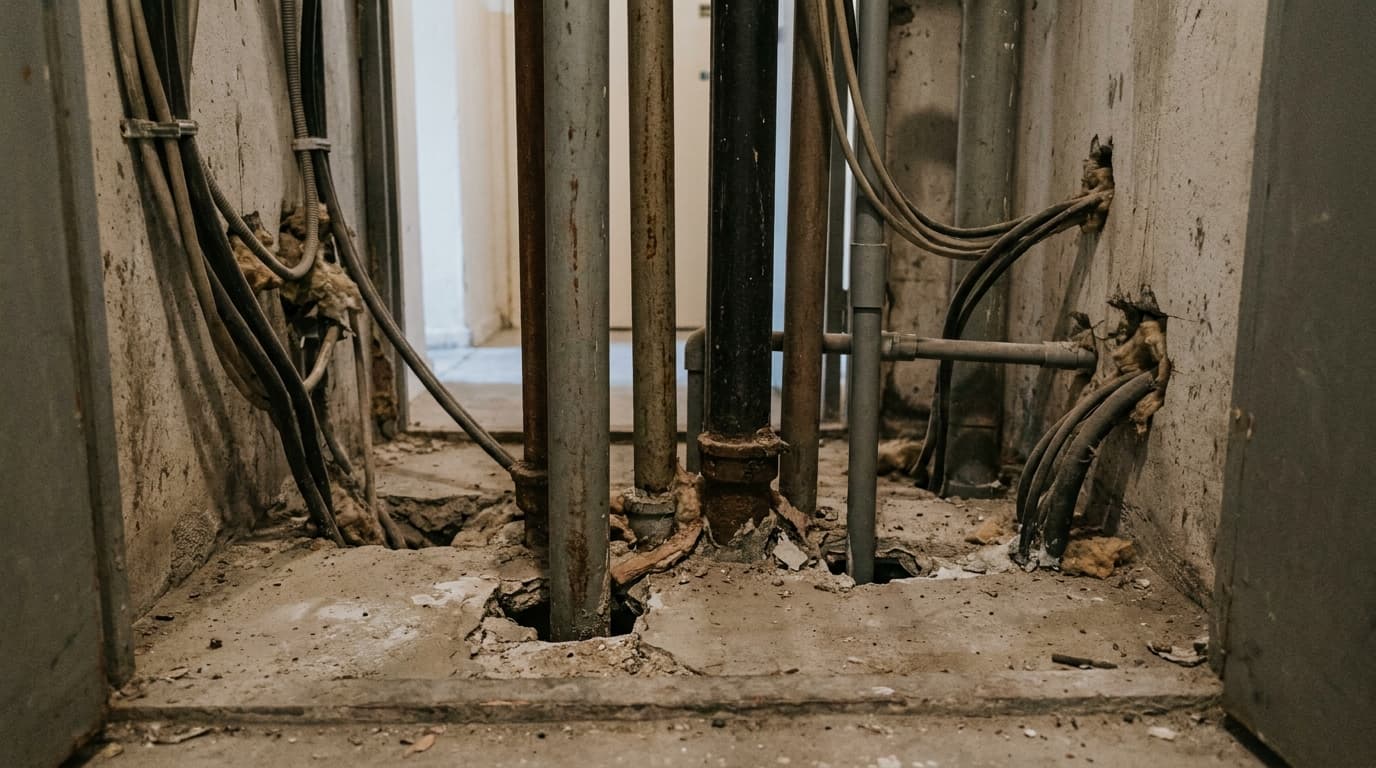
The second fact is how the buildings were put together. System construction means continuous horizontal and vertical service routes: ducts carrying heating pipework, riser shafts, boxed services behind bathrooms and kitchens, and undercrofts beneath the raised walkways and garage decks. Those routes were built to move pipes between homes efficiently, and they move rodents and cockroaches between homes just as efficiently. A provider treating a single reported flat is treating one door on a corridor it cannot see.
Nightshift works this kind of stock at block level rather than by complaint. That means surveying the duct runs and the external margins together, deciding where the population is actually being supplied from, and giving the housing provider a schedule that can sit against a repairs budget instead of a growing queue of individual cases. Void properties are inspected, treated and proofed before re-let, when there is no household to work around and the service penetrations can be closed properly.
Above the parapet there is a third problem that maintenance schedules routinely miss. Long flat roofs, plant decks and the recessed ledges of the older concrete blocks are attractive nesting ground, and near open water gulls join the pigeons. The fouling blocks rainwater outlets long before anybody complains about the mess, and a blocked outlet on this stock becomes a water ingress report and then a damp report. Bird proofing, and hawking where proofing is not appropriate, is work we carry out ourselves rather than subcontract. Technicians are on shift through the night, so communal areas and walkways can be worked when residents are not moving through them, and every visit produces a written report the same day.
The building stock
System-built concrete blocks and low-rise terraces from the late 1960s and 1970s, with continuous service ducts and riser shafts linking dwellings, raised pedestrian walkways over undercrofts and garage decks, extensive flat roofs and plant areas, communal bin stores and refuse rooms, all set within a designed landscape of lakes, canals and surface water drainage channels, alongside later infill housing of conventional construction.
Where the pressure comes from
The waterways are the reservoir
Lakes, canals, ditches and surface water culverts give a rodent population permanent cover, water and a route that does not pass through anybody's front door. Activity reported inside the blocks is frequently the visible edge of something living in the landscape. We survey the margins and the culvert access points as part of the same job rather than treating the reported address in isolation, because a programme that never touches the reservoir never finishes.
Service ducts that connect every flat
Boxed pipework, heating duct runs and riser shafts pass continuously through the structure, so a single infested dwelling is connected to its neighbours by a route nobody can see from inside either home. This is why activity appears to jump between unrelated flats. The duct run has to be opened and inspected at intervals, and the penetrations sealed at each dwelling, or treatment simply moves the problem along the corridor.
Undercrofts, walkway decks and garages
The space beneath raised walkways and over garage decks is sheltered, poorly lit, rarely inspected and often used for storage or fly-tipped material. It is ideal harbourage sitting directly beneath occupied homes. Clearing and proofing it is unglamorous work that removes more pressure than any amount of baiting inside the flats above it.
Gulls and pigeons on long flat roofs
Near open water the roofscape carries gulls as well as feral pigeons, and both foul rainwater outlets, plant and walkway surfaces. Blocked outlets on this stock turn into ingress and then into damp and mould cases with a statutory clock attached. Proofing, netting where it suits the elevation and hawking where it does not, keeps the roof draining and keeps a bird problem from becoming a housing disrepair problem.
Communal refuse rooms and chutes
Shared bin rooms serving many dwellings concentrate food waste in one place at the base of the building, usually adjoining the very service routes that reach every flat. Where a chute is in use the hopper doors and the chamber below need to be part of the programme rather than left to cleaning. This is the most common single reason a treated block reinfests.
Who we work for in Thamesmead
- Housing associations and registered providers
- Local authority housing and ALMO teams
- Managing agents and block management companies
- Schools, nurseries and community buildings
- Health centres and community care premises
- Local retail parades and food businesses
Common hotspots
- Lake and canal margins, ditches and reedbeds
- Surface water culverts, outfalls and rodding access
- Heating duct runs and boxed pipework between dwellings
- Riser shafts and service penetrations at each flat
- Undercrofts beneath raised walkways and garage decks
- Communal bin rooms, chute hoppers and refuse chambers
- Flat roofs, rainwater outlets and plant decks
- Void properties standing empty between tenancies
- External stores, drying areas and fly-tipped material
Questions we are asked in Thamesmead
- Activity keeps coming back after treatment. Why?
- On this stock the usual answer is that the population is not living where it is being reported. The waterways, culverts and undercrofts hold it, and the flats are where it becomes visible. We survey those margins alongside the buildings and say in the report where the source actually sits, including when the fix is a drainage or landscape repair rather than a pest treatment.
- One flat is infested. Do we need to treat the whole block?
- Not automatically, but you do need to know what that flat is connected to. Duct runs and riser shafts link dwellings that share no wall, so we inspect the route rather than assume it. That tells you whether this is one dwelling or one corridor, which is the difference between a small job and a programme.
- Can you work in communal areas without disrupting residents?
- Yes. Technicians are on shift through the night rather than called out from home, so walkways, bin rooms, duct runs and stair cores can be surveyed and treated when residents are not moving through them. The written report is issued the same day either way.
- We have gulls as well as pigeons. Is that different work?
- It is. Gulls are larger, more persistent and nest differently, so proofing that holds pigeons off a ledge will not always hold gulls off a flat roof. We survey the roofscape as a whole and use proofing, netting or hawking according to what the elevation and the species actually need. Bird work is carried out by our own teams.
- Do you treat properties before we re-let them?
- Yes, and it is the cheapest point at which to do it. An empty property can be inspected, treated and proofed with unrestricted access, so service penetrations and duct entries can be closed properly rather than worked around. We report what was closed so the next tenancy begins from a known position.
- A resident has raised a formal complaint. What record do we get?
- A written report the same day as each visit, showing what was found, what was done, what access was achieved or attempted and what remains outstanding, including where the outstanding item belongs to somebody else. That is the record that answers an escalation, and it is produced as routine rather than assembled afterwards.
Related services
Pest control across other London districts
Arrange a survey in Thamesmead
Free and without obligation. Call 01892 871008 or request a survey. We answer 24 hours a day.