


Nightshift Pest Control
News & analysis ·
Residents of three council-owned tower blocks in south Bristol went to their local paper this week about bed bugs. The blocks hold around sixty homes each and several hundred residents between them. The infestation became serious more than a month ago, during the heatwave. Residents say they have been told there is a waiting list for individual flats.
The local authority told the paper that reports are passed to a specialist contractor, which assesses each property individually. Notices in the blocks ask residents to bag and seal anything they throw out and not to drag furniture through communal corridors unbagged.
Everything in that account is a reasonable thing for a housing provider to do. That is what makes it worth writing about. Nothing here is negligence, and we are not going to pretend it is. It is a process that is correct at every individual step and still loses, because the unit it works in is the wrong one.
A queue is ordered by who complained, not by where the bed bugs are
A complaint-led list is sorted by the date somebody picked up the phone. That is not the same as the date an infestation started, and it is not even loosely correlated with how bad a flat is.
Reporting lag varies enormously between households in the same block. People who have had bed bugs before recognise them in days. People who have not will spend weeks assuming the bites are something else. Some households will not report at all, because they believe they will be blamed, or blamed for the state of the flat, or because English is not their first language, or because they are elderly and the prospect of the flat being emptied is worse than the bites.
So a queue in complaint order systematically puts the households who are quickest to speak up ahead of the households where the problem is worst. Every week the queue runs, it spends its capacity in roughly the wrong places, and the flats that never reported keep seeding the ones that did.
The unit of work is the cluster, not the flat
Bed bugs in a block do not respect the boundary a work order is written against. They move through service penetrations and along the gaps that carry pipes and cables between dwellings, and they are carried on objects and on people through the parts of the building everyone shares.
Which means a positive flat is not a case. It is a location. What matters is what is above it, below it, either side of it and along that stretch of corridor. Treating the flat that reported and closing the job is how an outbreak survives a year of diligent work: each treatment is genuinely successful, and the population is simply somewhere else by the time you get back.
The alternative is not more treatment, it is different surveying. When a flat comes back positive, you survey its neighbours whether or not they have complained. That sounds expensive and it is cheaper, because most of those neighbours will be clear and you will have proved it.
He has seen at least 20 beds, mattresses and sofa beds thrown out by other residents in his block alone.
That number is the most useful thing in the article, and it is not a measure of how bad the infestation is. It is a measure of how many households decided, unprompted, to try to solve it themselves.
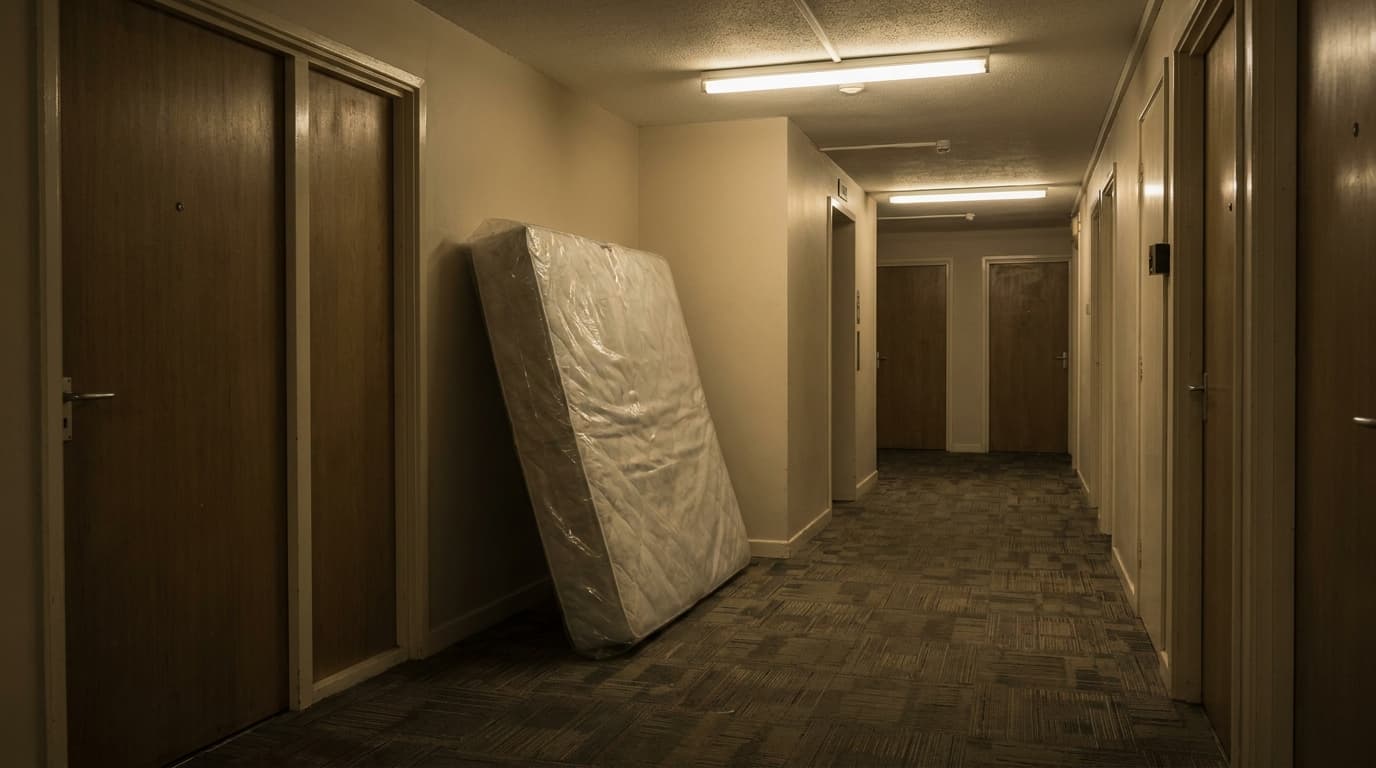
The disposal route is a transmission route
Telling residents to bag and seal before they carry anything out is exactly the right instruction. It is also a control that depends entirely on hundreds of people complying, at the moment they are most distressed, usually late at night, with something bulky and awkward.
The instruction will mostly be followed and it will not always be followed, and the exceptions all take the same path: along the corridor, into the lift, through the lobby, past the doors of flats that were clear. A disposal route that runs through the communal circulation of the building is a transmission route with a notice on it.
Where a provider has any choice about it, the useful intervention is a route and a container that does not pass other people's front doors, and a collection quick enough that nothing stands in a lobby overnight. That is a caretaking and logistics decision rather than a pest control one, which is precisely why it tends not to get made.
The void is the one flat you can treat today
Empty flats in an affected block are worth more attention than they get, for an unglamorous reason: nobody in them complains, so they never enter a complaint-led queue.
A void between two occupied flats is a refuge with no one to notice it, and it is also the single easiest unit in the building to deal with properly, because there is no appointment to arrange, no access to negotiate and no belongings to work around. Treating and proofing voids while they are empty, and doing it before re-let rather than after the new tenant reports something, is the cheapest work available in this whole situation.
The constraint is usually access, not technicians
When a waiting list forms, the natural reading is that there are not enough technicians. In our experience that is rarely the binding constraint. What actually consumes the capacity is failed access: appointments in the working day, for households who are at work in the working day, with the visit recorded as attempted and the flat going back on the list.
A programme that reaches residents in the evening and at weekends completes a far higher proportion of the visits it books, and a queue clears at the rate of visits completed rather than visits offered. Nightshift works nights as the standard shift rather than as a chargeable call-out, so that is not an upgrade we sell against this problem, it is simply when we work.
Measure whether the new cases are inside the cluster
The reporting on a job like this usually counts activity: visits completed, jobs closed, average days to attend. Those numbers can all improve while the outbreak grows, which is how a provider ends up genuinely surprised a year in.
The number that tells the truth is where the new positives are. If new cases keep appearing in flats already inside a surveyed cluster, the treatment is not holding. If they keep appearing outside it, the surveying is too narrow. Either way it is a question the reporting should be able to answer on demand, and on most contracts it cannot, because the data was collected one work order at a time.
What this means for your site
If you manage blocks and you are running a bed bug queue, the question worth asking is not how long the list is. It is what unit the work is ordered in. A queue of individual flats in complaint order will stay behind the infestation however fast it moves. Surveying by cluster, taking the voids while they are empty, controlling the disposal route and booking visits at times residents are actually at home are what change the shape of it. We survey and quote for this without charge, including where the honest answer is that the building needs a caretaking change rather than a bigger pest contract.