


Nightshift Pest Control
News & analysis ·
A London office dealt with bed bugs this month by treating part of a floor and telling staff they could work from home if they preferred. A first deep clean was done, more sightings followed, and further treatment was arranged.
Nothing in that is unreasonable. Sending people home while a floor is treated is a kind and sensible thing for an employer to do, and most of the coverage has been about the working-from-home part. The pest control question underneath it has had less attention, and it is the one that decides how long this goes on.
We have not surveyed this building and are not going to diagnose it from news reports. What follows is what an office with bed bugs should be asking its contractor, whoever the building is.
Sending people home empties the room, not the building
Bed bugs in a workplace do not live on people. They live in the furniture: the seams and foam of upholstered task chairs, the underside of desks, the joints of soft partition screens, and the warm, undisturbed spaces around cable trays and power boxes. Removing the staff removes the food source from the room. It does not remove anything from the floor.
That matters because the obvious hope, that an empty office starves the problem out, does not hold on any timescale an employer would accept. Bed bugs survive long periods without feeding, and a quiet floor is a better place to be undisturbed, not a worse one. A building that is closed and untreated is simply a building where nobody is being bitten yet.
Hot desking spreads it by policy, so the seating plan is the map
The difference between an office and a hotel or a block of flats is that the occupants move. Where people sit in a different chair each day, an outbreak that starts in one bank of desks is distributed by the seating policy itself, and the pattern of reports tells you about people's habits rather than about the insects.
So the useful document at the start of a survey is not the list of who reported bites. It is the seating and booking data, and the record of which chairs have been moved between banks, which is exactly the thing an office rarely keeps. Where it does not exist, the survey has to treat the whole floor plate as one unit and work outwards from the furniture rather than from the desks that complained.
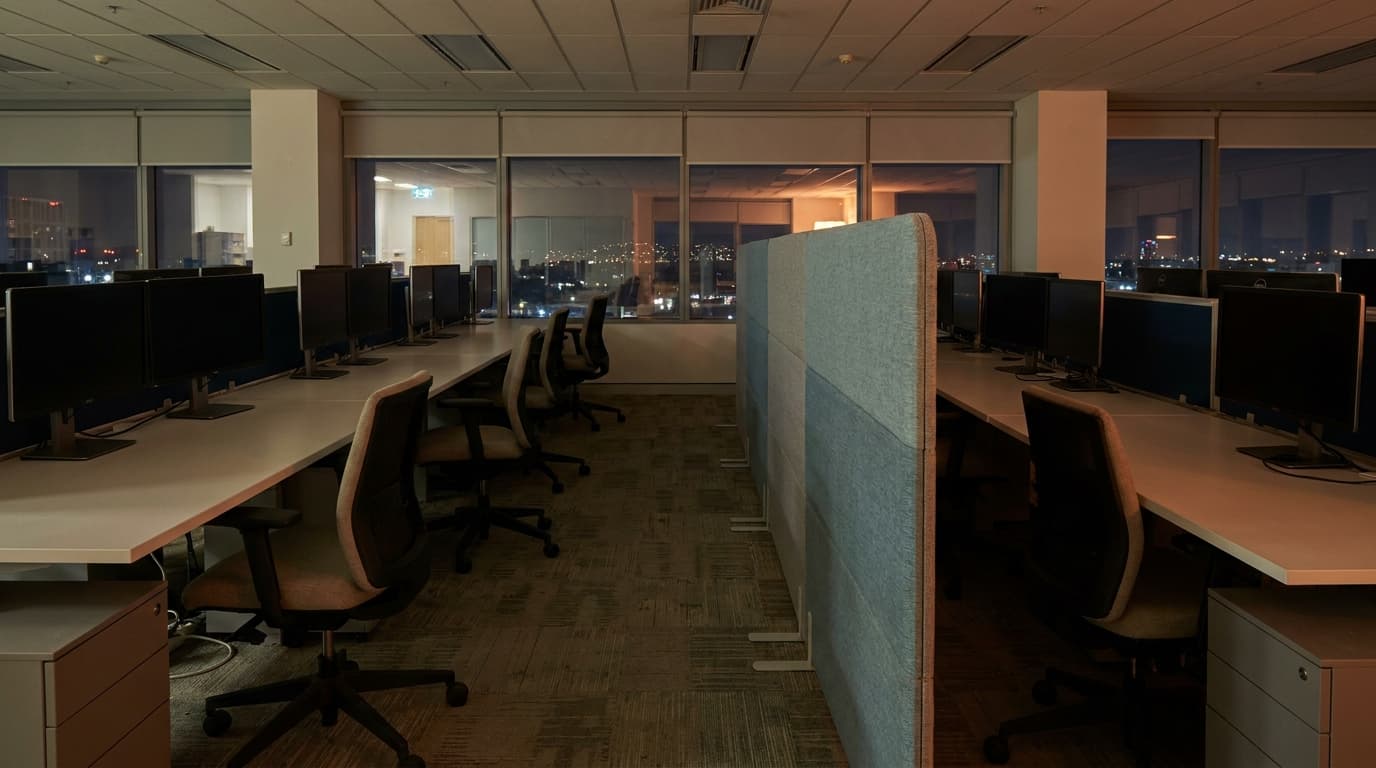
An office is the easiest building of all to treat, and the hardest to book
A hotel has guests at all hours. A hospital never closes. A block of flats needs access to a hundred private homes. An office is empty by design, every night, for eight or ten hours, and it is the same empty floor every time.
So the constraint on an office programme is almost never the treatment. It is the building: security passes, IT restrictions on moving equipment, cleaning contractors working the same hours, and a facilities team that has to agree all of it. That is the part worth sorting out in the first meeting rather than the third. Nightshift works nights as its standard shift rather than as a call-out, so the hours are not the obstacle at our end.
The return date should be a monitoring result, not a calendar date
The pressure on an employer is to name the day the floor reopens. The honest answer is that the date depends on what the monitoring shows, and that treatment for bed bugs is a sequence rather than a single visit, because eggs already laid are not reached by the first treatment.
What a facilities team should ask for is what will be in place between visits and what result unlocks the return: interceptors and monitors under the furniture, in named locations, checked on a stated schedule, and a written report after each visit saying what was found where. A date set before any of that exists is a guess, and the cost of getting it wrong is a second announcement to the same staff.
Say what people should do with the bag they take home
The one thing a work-from-home instruction should carry, and usually does not, is a line about what goes home with people. Bed bugs travel on bags, coats and laptop sleeves rather than on skin, and an office that sends three hundred people home for a fortnight has moved three hundred bags out of an infested building and into houses.
The advice is undramatic: keep bags off upholstered furniture and beds at home, hard floors or a hard surface are better, and anyone who thinks they have brought something home should say so rather than deal with it quietly. An employer who asks that plainly, without implying blame, gets told about the first flat before it becomes the fifth.
What good looks like on paper
A workplace programme that is actually working produces three things. A survey that covers the floor plate and the furniture rather than the reported desks, with canine detection where it is worth identifying which areas carry live activity instead of treating everything on suspicion. A treatment sequence with dates, done when the building is empty. And monitoring that stays in place afterwards, with a written report each time, so that reopening is a decision someone can defend.
What this means for your site
If your building has bed bugs, the questions worth asking your contractor are these. What is the unit being treated, the furniture across the floor plate or the desks that reported. When does the work happen, and does it fit the hours the building is actually empty. What monitoring goes in, where, and what result reopens the floor. And what are staff being told about the bags they take home. Nightshift surveys and quotes for commercial premises at any hour, including where the answer is that the seating policy needs changing rather than the treatment.