


Nightshift Pest Control
News & analysis ·
Residents of a 26-home social housing block in Bristol told their local paper this month that the building has had rats since 2024, about a year after it opened. Between them, four households described droppings in flats and on a terrace, rodents heard inside a bedroom wall, and power cuts caused by rats chewing through cables.
They also described how the rats got in and how the problem has been handled. The door to the bin store, they said, was broken for close to a year before it was repaired, leaving a way in from the street. They described holes that let rodents move from inside the walls into the communal areas. Broadband engineers declined to work in the bin store, and one who lifted a ceiling tile elsewhere in the building had droppings fall on him.
The housing association told the paper it had invested in specialist treatment and proofing over the past month, including proofing the top and bottom floors to restrict movement between them, with external proofing under way and communal works and a deep clean of the bin store to follow. Residents who reported rats inside their homes have been given somewhere else to stay, and the association is working with the council's environmental health team.
We have not seen this building and are not going to diagnose it from a newspaper. One resident said something, though, that deserves to be taken seriously on its own terms, because it describes a failure that turns up in blocks everywhere.
I think what they've done is seal up the bin room, but all the rats are now stuck in the walls of the building.
Closing the way in is not the same as getting the rats out
Rats that have moved into a building do not live in the bin store. They feed there. They live where it is dark, warm and undisturbed: ceiling voids, the cavities behind plasterboard, the risers that carry pipes and cables up through every floor. The bin store is the kitchen. The walls are the house.
Seal the kitchen while the house is occupied and the rats do not leave. They lose their food and look for the next nearest supply, and in a block of flats that is behind the kitchen units of the homes on the other side of the wall. A resident who says sealing the bin room has pushed the rats into the building is not misunderstanding rats. That is a fair description of what they do.
None of that makes proofing the wrong call. Proofing is what stops an infestation coming back, and a block treated without it is signing up for the same job every year. The question is order.
The order that works
First, find out where they live. That means looking inside the structure, not only in the places residents can see: monitoring points in the ceiling voids and risers, tracking dust along the likely routes, and a survey of the drains, because a defective drain connection is a common way for rats to reach a building that looks sealed from outside.
Second, bring the population inside down while the building is still showing you where it is. Activity on monitoring points is the map. Close the routes too early and the map goes blank, not because the rats have gone but because they have stopped using the routes you are watching.
Third, proof the internal routes, the gaps around pipes and cables where they pass between voids, flats and communal areas. Then the building envelope, closing the last entry points once activity inside has fallen away.
Last, prove it. Rats are most active after dark, and a daytime look into a quiet ceiling void proves very little. Nightshift works nights as the standard shift rather than as a call-out, so checking a void when rats would actually be using it is ordinary working hours for us.
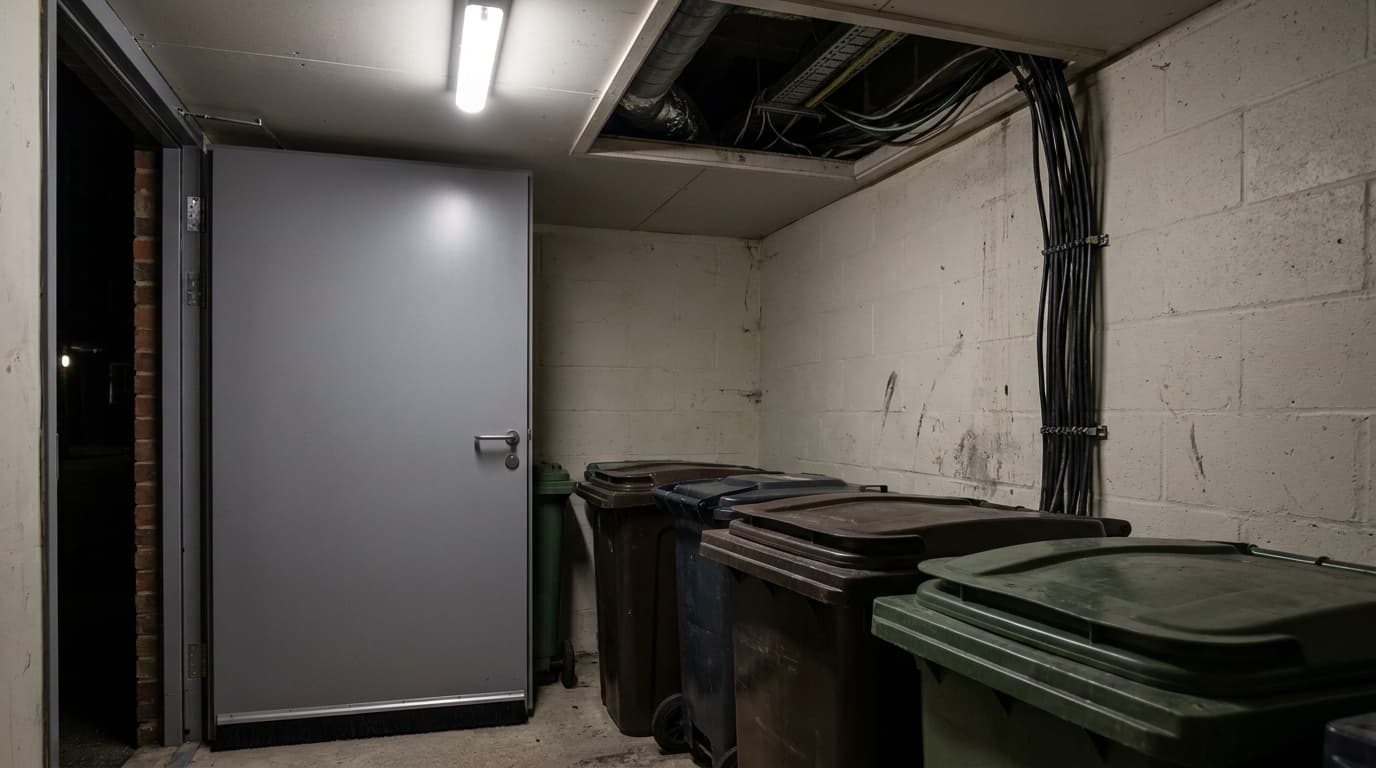
A broken door is a pest control job
The detail in this story that anyone who manages blocks will recognise is the door. A communal door that does not close gets logged as a communal repair, and communal repairs queue behind anything that affects a single household more urgently. In pest terms it is an open entry point beside the building's food supply, and every week it stays open adds to the population the eventual treatment has to deal with.
The fix is administrative rather than technical. Defects that open a way in or give access to food, such as bin store doors, damaged air bricks, broken drain covers and gaps under doors, should carry a pest priority in the repairs system with a short target time, and the pest contractor should be able to see that list.
Newer buildings are not safer, they are better connected
It is natural to read an infestation in a building barely a year old as a sign that something went badly wrong. More often it reflects how modern blocks are built. Every flat is connected to shared voids and risers by the pipes and cables that serve it, and the holes cut for those services are only as rodent-proof as whatever was used to fill them. Expanding foam fills a gap neatly and is no barrier to a rat.
Those are the same penetrations fire-stopping exists to seal, so a fire-stopping inspection and a proofing survey are looking at the same holes. Where a provider is already opening up risers and ceilings to check compartmentation, adding a proofing check closes the routes a rat would use for very little extra access. Proofing at those points has to preserve the fire-stopping rather than replace it, which is one more reason to do the two together.
Chewed cables are the point where this stops being a nuisance and becomes a building safety matter. Residents here reported power cuts. A cable that has been gnawed but not yet severed is a fire risk nobody has reported, because nothing has stopped working.
Moving residents out ends when the walls are quiet, not the flat
Moving households out while their homes are dealt with is the right call, and the residents here describe coming back to rats. That is what happens when a home is signed off on the state of the home. A flat can be clear on the day of the visit and still sit against a void that is not.
The sign-off worth asking for is monitoring inside the structure around that flat, the voids and risers behind its walls, showing no activity for a set period before anyone moves back. It takes longer. It is a great deal quicker than moving the same family out twice.
What this means for your site
If you manage blocks and rats are in the building, ask your contractor for the order of the work, not just the list of it: where the rats live, how you will know the population inside has fallen, which routes close first and why, and what monitoring has to show before a household moves back. Treat defects that let rats in or give them food as pest work with its own priority, and look at proofing alongside any fire-stopping survey that is already opening the structure up. Call any hour for a no obligation quote, including where the honest answer is a repairs change rather than a bigger pest contract.